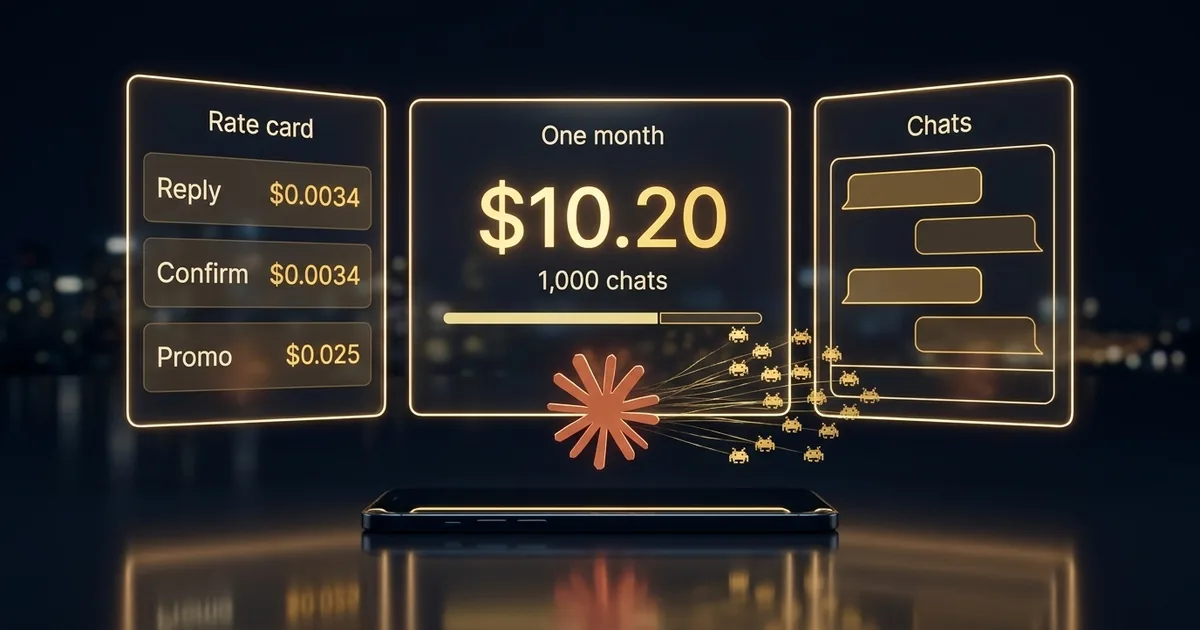
You can have 1,000 customers message your business on WhatsApp in a month and owe Meta about $10. That’s $10.20 on Meta’s own rate card, for three replies and one appointment confirmation per customer, if their phone numbers are in the US or Canada.
This guide prices Meta’s WhatsApp Business Platform, the connection that lets software send and receive WhatsApp messages for you (people call it the API). Prices and limits below come from Meta’s own pricing page and its USD rate card, as of November 19, 2026. Both are marked effective October 1, 2026.
What Does Meta Charge for One WhatsApp Message to a US Customer?
Between 0.34 cents and 2.5 cents for the four ordinary kinds, depending on what the message is for. Meta bills each message it delivers from your business to a customer. Messages your customers send you are free. The price follows the message type and the country code of the phone number you’re writing to.
| Kind of message | What it is | Meta’s price per delivered message to a +1 number |
|---|---|---|
| Service | A reply inside 24 hours of the customer’s last message | $0.0034, with the first 1,000 a month free |
| Utility | A confirmation, receipt or reminder sent as a template | $0.0034 |
| Authentication | A login code sent as a template | $0.0034 |
| Marketing | A promotion sent as a template | $0.025 |
| Meta Business Agent | A reply written by Meta’s own AI | $2.00 per million tokens, about 4 to 5 cents a message |
A template is a message you set up ahead of time. It’s the only kind a business can send first. Meta calls the +1 market North America, and it covers the United States and Canada. Source: Meta’s USD rate card, effective October 1, 2026.
Until September 30, service replies were free, and so were confirmations sent inside a customer’s 24-hour window. Meta charges for both now. The free 1,000 replies are the cushion, and Meta’s page puts it plainly:
Meta only charges as of the 1,001st service message for each business phone number.
What Do 1,000 Customer Chats Cost in a Month?
$10.20, on three assumptions. Each customer gets three replies and one appointment confirmation. Every customer has a US or Canadian number. The replies come from a person, or from an AI that isn’t Meta’s own.
| Line | Messages | The math | Meta charges |
|---|---|---|---|
| Replies (service) | 3,000 | 3,000 minus the free 1,000, then 2,000 at $0.0034 | $6.80 |
| Confirmations (utility) | 1,000 | 1,000 at $0.0034 | $3.40 |
| One month | 4,000 | $10.20 |
That’s about a cent a chat. Does your average chat run to three replies, or six? At six, the month goes to $20.40. The free 1,000 belongs to one business phone number, so a second number gets its own.
Does the Bill Change if the Customer Came From an Ad?
It can drop to $0.00. When a customer messages you from a Click to WhatsApp ad in the phone app and you answer inside 24 hours, Meta doesn’t charge for your marketing, utility, authentication or service messages for up to 7 days. The window needs the Android or iOS app, since Meta says the desktop and web apps aren’t supported. Meta Business Agent messages are still charged inside it.
So the same 1,000 chats cost $0.00 in Meta fees if every message goes out inside that window. The ad itself is a different bill. Do your customers start from an ad, or from the number on your sign?
What Happens to the Bill When an AI Writes the Replies?
It depends on whose AI it is. Meta counts replies from any AI that isn’t its own as service messages, the same as a person’s. Its page says they “can be powered by a 3rd-party AI solution or people.” You pay Meta $0.0034 a reply after the free 1,000, and you pay the AI’s maker separately. Meta’s page estimates that at about 9 cents a message for a higher-complexity model, in a Brazil example.
If the AI is Meta’s own, one per-token charge covers the AI’s work and the delivery. A token is a small chunk of text a model counts and bills by. Meta’s rate is $2.00 per million tokens, and its page says one message typically uses 20,000 to 25,000 of them. That’s the 4 to 5 cents. Three thousand replies come to $120 to $150 on that math, against $6.80 from a person. Don’t read that as a verdict, because the 4 to 5 cents includes the AI’s work and the $6.80 doesn’t.
Is your most common question the same ten answers every week, or does each one need judgment?
What if Your Customers Aren’t in the US?
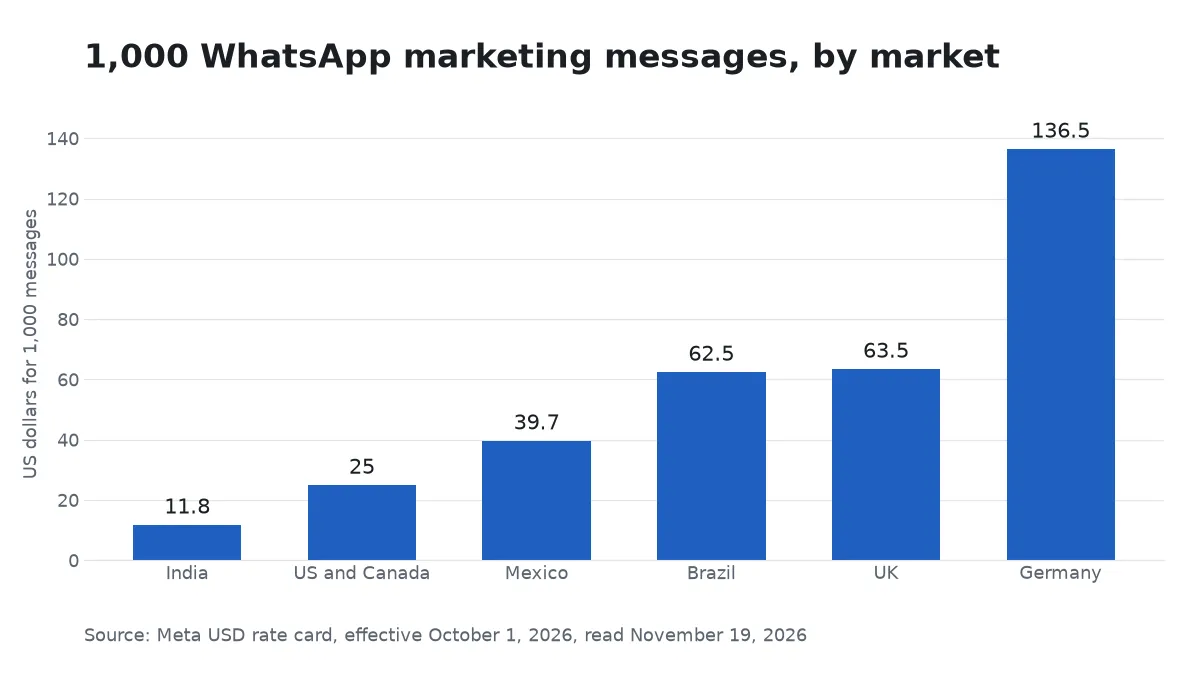
The price follows the customer’s phone number, not your address. Meta rates each message by the recipient’s country calling code. The same 1,000 promotional messages cost $25.00 to US and Canadian numbers, $136.50 to German ones and $11.80 to Indian ones.
How Do You Price Your Own Month?
Price it from Meta’s file, not from a blog, this one included. Four steps:
- Open Meta’s pricing page and download the rate card for your currency. Meta labels the file a CSV, but it’s an Excel workbook, so save it ending in .xlsx.
- Find the row for your customers’ country calling code. A country Meta doesn’t name falls under a “Rest of” region or “Other.”
- Count a normal month by kind: replies after a customer writes, confirmations and reminders you send, promotions you send first.
- Take the first 1,000 replies off for each business phone number, then multiply each line by its rate.
Meta says it may change prices only on January 1, April 1, July 1 or October 1, with at least a month’s notice for a rate change. The page lists no rate change for January 1, 2027. Look again in early December.
Every figure here is Meta’s list price, and tax isn’t in it, so check how tax applies to you. If a software provider sends your messages, check its price list for what it adds on top. And before you count on the free 1,000, check in your account whether messages inside an ad window use it up.
Which question do customers text you most? If you’d like, send it to scoy.ai/five and I’ll say whether an AI could answer it.