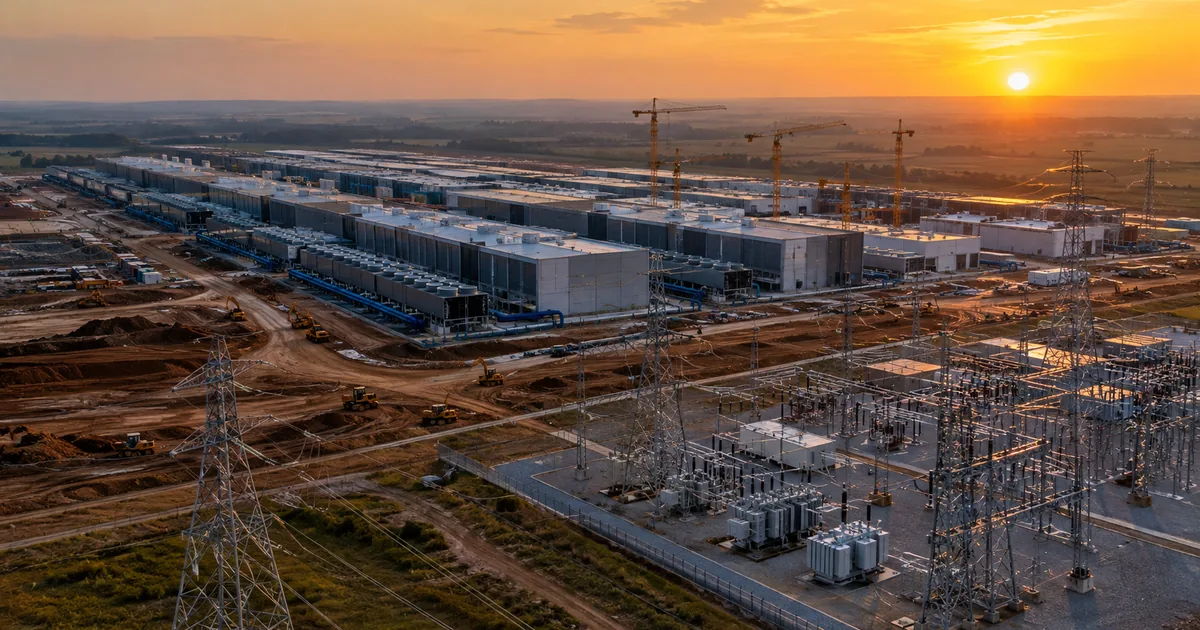
Tata Consultancy Services committed up to $7.4 billion to a one gigawatt campus in Telangana yesterday, and separately, the American AI industry has now pledged roughly $265 million to political groups ahead of the midterms. Every outlet I read filed the first as an India growth story and the second as a campaign finance story, and not one of them put the two in the same paragraph.
That is the gap, so let me close it. More than 99% of the $31 million spent on data center political advertising in the United States this year has been spent attacking data centers. When siting a gigawatt in an American county requires a counter-advertising budget, the political cost stops being a risk and becomes a line item. TCS is not paying that line item in Hyderabad. That is not a story about India winning. It is a story about what a US gigawatt now costs.
TCS Bought 264 Acres and Skipped the Argument
TCS subsidiary HyperVault will invest up to 700 billion rupees, about $7.4 billion, across 264 acres in Hyderabad, and The Next Web went through the numbers on Friday. The target is one gigawatt of high density, liquid cooled capacity aimed at frontier labs and hyperscalers, built in phases.
One detail from that writeup is worth keeping. TCS says the campus will run on green energy and water neutral design, and India requires no annual water reporting from data centers, while the EU requires it from any facility above 500kW of installed IT power. A green claim made where disclosure is optional is a press release, not a commitment.
The capacity number is the part worth holding onto. One gigawatt is roughly the scale of the Nueces County project Anthropic is renting into through Lambda, and it is being built by a services company that has spent thirty years being the place other people’s workloads go when those workloads get expensive at home. TCS is not making a bet on Indian AI demand. It is making a bet that frontier training capacity is about to become a thing you rent wherever it is politically cheapest to build, and that the answer will not be Ohio.
I think that bet is correct, and I think the next section explains why.
Ninety-Nine Percent of the Ad Money Is Pointed at You
Here is the number that should reset how you model compute costs for 2027. Tracking from AdImpact, reported by CNN, found that more than $31 million has gone into political ads mentioning data centers this year, and that last month more than 8% of all broadcast TV campaign spending went to data center or AI spots. That is up from under 1% last year. Of this year’s spending, more than 99% was against AI infrastructure.
An eight-fold jump in a single year, running better than ninety-nine to one against you, is not a messaging problem. It is a market.
Both parties are in on it. Democrats account for roughly 73% of that spending and Republicans roughly 26%, which is the detail that makes this durable. An issue that only one party runs on gets traded away after an election. An issue both parties are running on gets legislated.
The industry’s response is money. A Wall Street Journal analysis puts total AI industry pledges to super PACs and political groups at about $265 million this cycle. Leading the Future, funded in part by Marc Andreessen, Ben Horowitz and OpenAI president Greg Brockman with his wife Anna, has raised $140 million. Andreessen Horowitz alone has spread more than $115 million in disclosed federal contributions, which makes the firm a larger midterm donor than Elon Musk or George Soros. An affiliated group, Build American AI, is running ads in Kansas, Ohio and Wisconsin arguing that voters should want the campus.
Anthropic sits on the other side of its own industry. The company has now put $40 million into Public First Action, confirming the second $20 million tranche on its own site, a 501(c)(4) that backs candidates of both parties who support AI safeguards. Anthropic says both donations fund public education and policy work and cannot be used to influence any candidate’s election. Public First Action is tied to three super PACs. I will let you decide how much that firewall is worth, but I will say plainly that a company arguing for its own regulation with $40 million is doing something more interesting than the $140 million arguing against it.
My read: the counter-advertising will not work. You cannot ad-buy your way out of a utility bill. The opposition here is local, it is bipartisan, and it is about rates and water rather than about AI, which means pro-AI messaging does not answer it. Expect US siting timelines to stretch, expect capacity to keep pricing accordingly, and expect more announcements that look like Telangana.
The Seattle Times Is Not Asking to Get Paid
The Seattle Times and Newsday sued OpenAI and Microsoft in the Southern District of New York on Thursday, and TechCrunch has the filing details. The complaint alleges methodical scraping that reached behind subscription paywalls.
Skip the damages claim and read the remedy. The publishers are asking the court for the impoundment and destruction of the datasets and the models that contain their articles. That is a different ask from the licensing fights we covered in the August 30 roundup, where the plaintiffs wanted a price. A plaintiff who wants a check wants you to stay in business. A plaintiff who wants your weights deleted does not.
Nobody has won that remedy yet and I do not expect these two to be first. But it is now the standard ask in the complaint template, and if you have built anything load bearing on a single closed model, the tail risk you are carrying is no longer “my vendor raises prices.” Know which of your workloads would survive a forced retraining of the model underneath them, and know it before a judge makes it interesting.
Qwen’s Number One Is Four Points Wide
Alibaba shipped Qwen3.8-Max-0902 on September 2, a post training refresh with the architecture untouched: the same 2.4 trillion parameter mixture of experts, the same one million token context, the same $2 and $6 per million tokens. Then it took the top slot on Code Arena’s WebDev board, and Arena’s own announcement put it at 1,691 against Claude Opus 5 (Max) at 1,687.
Arena described that as three points. The published table reads four. When the winner and the scorekeeper cannot agree on the size of the gap, the gap is not the story.
What is real: an open weight model from Alibaba is now genuinely at the frontier for agentic web development at a blended $5 per million tokens, and it took first in Data and Analytics and in Consumer Product while landing second in Brand and Marketing. That is a serious result and it should change your evaluation shortlist. What is marketing is “#1,” a label that a four point Elo difference on a preference leaderboard cannot support. Run it against your own tasks. If you want the practical version of that comparison, our Claude vs ChatGPT breakdown is built the same way: on what the thing does in a real workflow, not on where it sits on a board.
Thirty-Nine Campaigns Bought ChatGPT. Two Broke the Rule.
A Washington Post analysis of FEC filings found 39 congressional candidates paying for OpenAI subscriptions this cycle. It got aggregated into headlines about campaigns violating OpenAI’s political ban, and that framing is wrong. Buying a subscription is not a violation. Two candidates disclosed using theirs for advertising, which is the thing OpenAI’s usage policy actually prohibits, and a third admitted to unspecified AI use for drafting or synthetic media.
So the real number is two or three, not 39. It is a smaller story than it was sold as, and it is still the one I would pay attention to, because of how we found out: somebody read expense lines on a federal disclosure form. OpenAI did not catch it. The FEC has still not finalized binding rules on disclosing AI generated campaign content. If your compliance posture assumes your model vendor is enforcing its own acceptable use policy, today is a good day to notice that the enforcement mechanism here was a reporter with a spreadsheet.
What I Would Actually Watch Is an Electric Bill
Not a benchmark, and not a filing. The variable that decides how much your inference costs in eighteen months is whether a county commission in Ohio approves a substation, and right now the ads running in that county are ninety-nine to one against it. TCS just voted on that question with $7.4 billion, and it voted somewhere else.