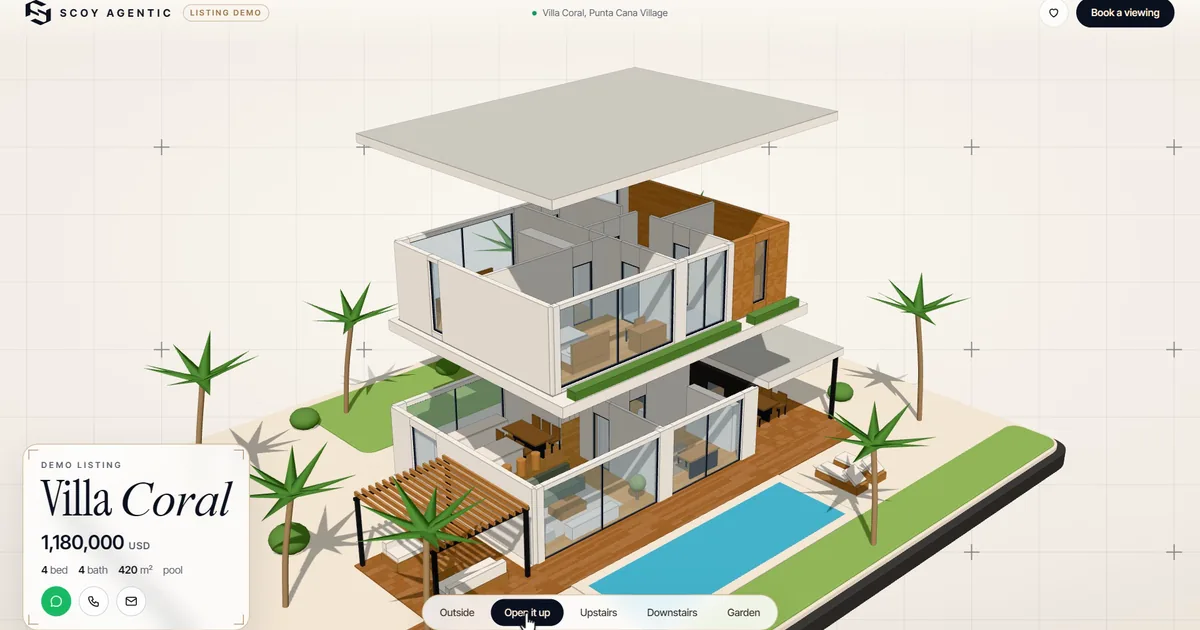
You can hand a buyer the whole villa before the concrete’s poured. They open the roof, pull the floors apart, tap a room, and ask you about it on WhatsApp, so the lead lands with the room already named. It’s built from the plans, so it works on a house that’s still on paper. Watch the demo first. It’s 27 seconds.
What Does a Buyer Get That a Photo Gallery Can’t Give Them?
They get the layout, which is the thing they’re actually trying to picture. Here’s what happens in the demo, in order:
- They see the finished house. The pool, the deck, the timber, the palms. It turns slowly while they look.
- They open it up. The roof floats off and the upper floor lifts away, so every level hangs in the air at once. That’s the floor plan, in three dimensions.
- They pick a room. The house settles onto that floor and a card slides in with the size, the view and the storage.
- They ask about it on WhatsApp. The message already names the room, so your first reply isn’t “which property?”
- They go downstairs and turn the house to see how the kitchen meets the pool terrace.
Every one of those steps is a click, so it’s a real page, not a video of a page. The clip above is that page recording itself.
Why Don’t More Listings Here Do This?
Because most of them are selling a house that doesn’t exist yet. A Punta Cana Village West listing for a five-bedroom villa marked “En Construcción” with delivery in August 2026 has seven photos, a written list of rooms and a WhatsApp button. It doesn’t have a floor plan or a tour.
The usual 3D tour can’t fix that. NAR’s guide to do-it-yourself 3-D listings describes the camera capturing 360-degree images of each room of a home. You need the home first. A villa that’s still a slab has nothing to photograph.
So which of your listings is still on paper right now? And what does a buyer ask you first when they message about it?
What Goes Into Building One?
The plans, mostly. The model is built in code from the floor plans, the room list and a few finishes, the same facts you already send buyers. Nobody has to visit the site, and nothing waits for the build.
The same page then records itself into the short video for your socials, with a voice reading over it and each click landing on the word that names it. Here’s what the recording of Villa Coral took:
| What | Villa Coral |
|---|---|
| Length | 27.6 seconds, 1920 x 1080 at 60 frames a second |
| Frames rendered | 1,657 |
| Render time | about 3 minutes on a laptop |
| Versions | 16:9 for YouTube and LinkedIn, 9:16 with captions for Reels and TikTok |
That vertical cut matters more than it looks. Most people scroll Reels with the sound off, so the captions carry the story when the voice can’t.
What Does a Person Still Check Before It Goes Live?
The room facts. Sizes, views and finishes come from the developer’s plans, and someone who knows the project reads every card before a buyer sees it. Plans change during construction, so the card should change with them.
The WhatsApp number. It has to reach a person who answers, because the whole point is that the question lands with the room attached. And the renders stay labelled as renders. A buyer who walks into the finished villa should recognise it.
How many of the questions you get on WhatsApp are really about one room? If it’s most of them, this is for you.
If you’ve got a villa on paper, book a call and bring the plans for one. One is plenty.